Qelvoriant
Vertex Stage
Vertex Stage
Couldn't load pickup availability
1. Problem Statement
As C# applications begin handling multiple operations at the same time, managing execution order and shared information introduces new technical challenges. Learners who understand asynchronous methods may still encounter difficulties distinguishing asynchronous execution from parallel processing and thread-based operations. When several tasks interact with the same data, unexpected changes and inconsistent results can become difficult to investigate. Synchronization mechanisms, cancellation behavior, and resource coordination also require careful attention to the relationships between application components. Without a structured understanding of concurrency, learners may struggle to explain why an application behaves differently across repeated executions or how its operations should be coordinated.
2. Solution
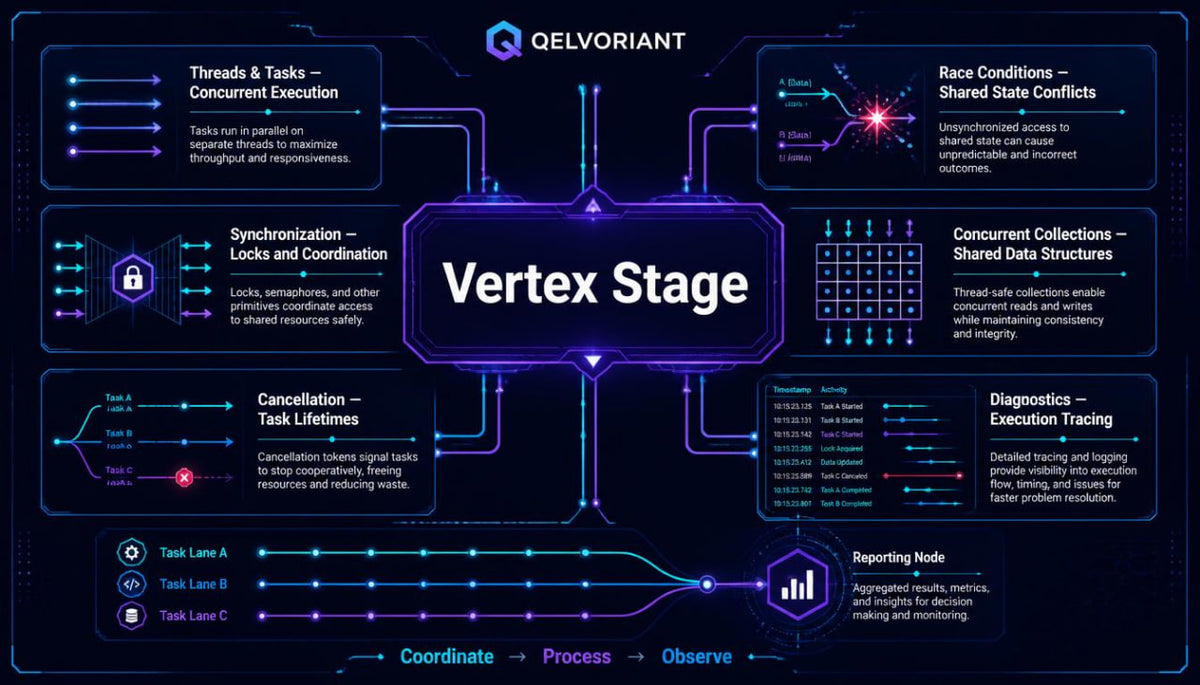
Vertex Stage introduces concurrency concepts through a connected series of C# lessons that examine execution, synchronization, and shared-state management. The course develops the relationship between threads, tasks, parallel operations, and asynchronous workflows through annotated examples. Each module presents practical situations involving coordinated processing, shared collections, cancellation, or unexpected execution behavior. Guided exercises encourage learners to examine execution sequences, identify conflicting operations, and compare different coordination techniques. The concluding workshop combines these topics within a concurrent record-processing application containing controlled task execution, shared data structures, and structured reporting.
3. What's Inside
Module 1 — Understanding Concurrent Execution
The opening module examines what happens when several operations make progress during overlapping periods of application execution.
Learners explore the relationship between sequential execution, concurrency, and parallel processing.
The materials explain how an application can organize independent work and why the order of individual operations may vary.
Examples introduce threads, tasks, and the circumstances in which each concept becomes relevant.
Learners also examine the difference between operations that wait for external activity and operations that perform computational work.
Practical exercises involve tracing execution timelines, identifying task dependencies, and describing how different operations contribute to an application's overall behavior.
Module 2 — Threads, Tasks, and Scheduling
This module develops the relationship between task-based programming and thread management.
Learners examine how C# represents scheduled operations and how task execution differs from creating and controlling individual threads.
The materials introduce task states, completion behavior, and the coordination of independent operations.
Annotated examples demonstrate Task.Run, Task.WhenAll, and task-returning methods in different programming situations.
The course also discusses how scheduling decisions influence the order in which calculations are performed.
Exercises invite learners to compare sequential and concurrent implementations, examine task completion sequences, and identify operations that depend on earlier results.
Module 3 — Shared State and Race Conditions
When several operations interact with the same information, their execution order can influence the resulting values.
This module introduces shared state and examines how race conditions arise.
Learners explore examples involving counters, record collections, and calculations performed by several concurrent tasks.
The materials demonstrate how individually understandable operations can produce unexpected results when their instructions overlap.
Special attention is given to reading and modifying shared values.
Practical activities involve tracing different execution orders, identifying conflicting operations, and examining methods of reducing unnecessary shared-state interactions.
The module concludes with an exercise in which learners investigate inconsistent results in a small record-processing routine.
Module 4 — Synchronization and Coordinated Operations
This section introduces synchronization mechanisms used to coordinate interactions with shared information.
Learners study critical sections, mutual exclusion, and the relationship between synchronization boundaries and application behavior.
Examples demonstrate the lock statement and selected synchronization objects.
The course also examines SemaphoreSlim as a mechanism for controlling how many operations enter a defined section of work.
Additional discussions introduce deadlocks and explain how conflicting acquisition orders can prevent operations from continuing.
Exercises involve identifying critical sections, examining resource acquisition, and comparing several synchronization arrangements.
Learners are encouraged to explain why synchronization is needed in a given situation rather than applying it to every operation indiscriminately.
Module 5 — Concurrent Collections and Data Integrity
Applications coordinating several operations may need specialized structures for managing shared information.
This module examines concurrent collections and their role in multithreaded C# workflows.
Learners explore ConcurrentDictionary, ConcurrentQueue, and related structures through practical examples.
The materials explain how these collections differ from ordinary collections when multiple operations modify their contents.
Examples involve maintaining shared record counts, organizing pending work, and collecting processing results.
The module also introduces the idea of reducing shared mutable state through separate data representations.
Exercises encourage learners to select suitable collection structures, examine concurrent updates, and review the consistency of calculated summaries.
Module 6 — Cancellation, Exceptions, and Task Lifetimes
Concurrent applications require clear rules for starting operations, responding to interruptions, and completing work.
This module explores cooperative cancellation and the management of task lifetimes.
Learners examine cancellation tokens, task completion states, and the difference between cancellation and unexpected failure.
Annotated examples demonstrate operations that periodically examine cancellation requests during longer processing sequences.
The materials also discuss exception propagation when several tasks are coordinated together.
Practical exercises involve tracing cancelled operations, examining incomplete processing stages, and determining what information should be retained after an interruption.
A concluding activity introduces a workflow that reports completed, cancelled, and unsuccessful operations as separate execution outcomes.
Module 7 — Observing and Testing Concurrent Behavior
Concurrent programming introduces behavior that may vary between executions.
This module examines how to investigate such behavior through controlled testing, recorded observations, and targeted code review.
Learners study the use of timestamps, task identifiers, and structured diagnostic records to understand execution sequences.
Examples demonstrate how repeated operations can reveal problems involving shared values or incorrect synchronization.
The materials introduce testing scenarios involving empty collections, overlapping tasks, cancellation requests, and deliberately varied processing order.
Exercises invite learners to compare expected behavior with recorded execution results and revise selected components.
The module concludes with a discussion of readable concurrency structures and the importance of documenting assumptions about shared information.
Applied Workshop — The Concurrent Record Observatory
The concluding workshop brings the technical subjects together through a structured C# application that processes fictional observation records.
Learners begin by examining record definitions, task responsibilities, and a processing workflow containing several independent operations.
The application organizes incoming records, distributes selected calculations across tasks, and collects processing summaries.
A shared collection stores selected results while synchronization controls operations that modify related information.
Additional stages introduce concurrent collections, controlled task execution, and cancellation handling.
Learners examine situations involving overlapping updates, incomplete tasks, and changes in processing order.
The workshop also includes diagnostic records that describe task activity and help explain observed behavior.
Review activities involve adjusting the number of concurrent operations, comparing alternative collection structures, and investigating different synchronization approaches.
The final exercise invites learners to add a new record category and revise the processing workflow while maintaining clearly defined component responsibilities.
4. Who Is This For?
Vertex Stage is intended for learners who already understand C# classes, interfaces, collections, asynchronous methods, and introductory application architecture.
The course is suitable for individuals interested in studying how multiple operations can interact within a connected application.
It may also be useful for learners who have encountered tasks, threads, or synchronization constructs in existing code and want to explore their underlying behavior through structured exercises.
Previous experience with async, await, exception handling, and collection operations is recommended.
The materials emphasize execution analysis, practical experimentation, and the careful examination of shared data.
Learners are encouraged to trace code behavior, investigate unexpected results, and compare alternative approaches to coordinating operations.
5. What You'll Learn
Through the written lessons and applied coding activities, learners will explore:
-
Concurrency fundamentals: Distinguish sequential, concurrent, and parallel execution.
-
Threading concepts: Examine threads and their relationship with scheduled operations.
-
Task coordination: Work with multiple tasks and interpret completion behavior.
-
Shared-state management: Understand interactions involving data modified by several operations.
-
Race conditions: Identify execution sequences that can produce inconsistent results.
-
Synchronization: Explore critical sections, locking, and controlled resource coordination.
-
Deadlock analysis: Recognize conflicting resource acquisition patterns.
-
Concurrent collections: Examine structures designed for shared data operations.
-
Cancellation handling: Incorporate cooperative interruption into task-based workflows.
-
Exception analysis: Investigate failures during coordinated execution.
-
Diagnostic techniques: Record and interpret execution behavior.
-
Concurrent testing: Examine alternative operation orders and unusual execution conditions.
-
Practical development: Build a connected record-processing application using concurrent C# techniques.
6. Course Purchase and 30-Day Refund Information
Vertex Stage is a paid C# educational course containing structured written lessons, annotated technical examples, programming exercises, and an applied workshop.
30-Day Refund Period
Learners may submit a refund request within 30 days of purchase, according to Qelvoriant's published Refund Policy.
The policy describes the applicable conditions, request procedure, and information concerning refund processing.
- 📥 Digital file available after purchase
- 📚 Long-term availability
- 🔒 Secure checkout
- 📅 Content updated in 2026
Self-paced learning overview
How are Qelvoriant courses organized?
How are Qelvoriant courses organized?
Our C# courses follow a structured approach that connects technical explanations with practical coding exercises. Each course covers a defined set of topics through written lessons, examples, and review activities. The collection progresses from introductory concepts toward deeper programming techniques and application design.
Do I need previous programming experience?
Do I need previous programming experience?
The required starting knowledge depends on the course you choose. Introductory materials explain foundational programming ideas, while later courses explore topics that benefit from earlier C# study. We recommend reading each course outline to understand its subject matter and suggested preparation.
Can I study the materials at my own pace?
Can I study the materials at my own pace?
The courses are arranged for independent study, allowing learners to work through the written explanations and exercises according to their own schedules. You can revisit earlier topics, examine code examples, and repeat practice activities when additional review is helpful.
Share