Qelvoriant
Neon Stage
Neon Stage
Couldn't load pickup availability
1. Problem Statement
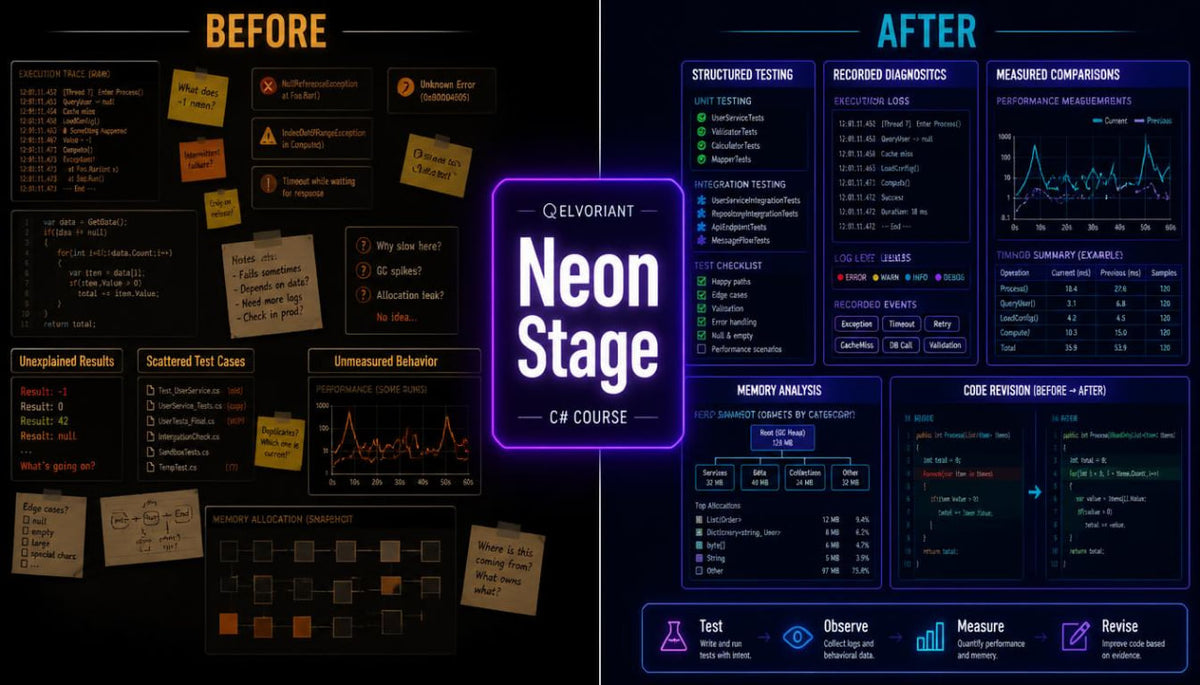
As C# applications become more complex, understanding whether their components behave correctly requires more than examining individual methods or reading the source code. Operations involving asynchronous tasks, shared resources, data processing, and interconnected classes can produce unexpected behavior that is difficult to reproduce. Learners may encounter slow execution, unnecessary memory allocation, inconsistent results, or errors that appear only under particular conditions. Identifying the cause of these issues requires knowledge of testing strategies, diagnostic information, execution measurements, and application structure. Without a systematic approach to examining application behavior, learners may struggle to distinguish between coding errors, inefficient operations, and architectural problems.
2. Solution
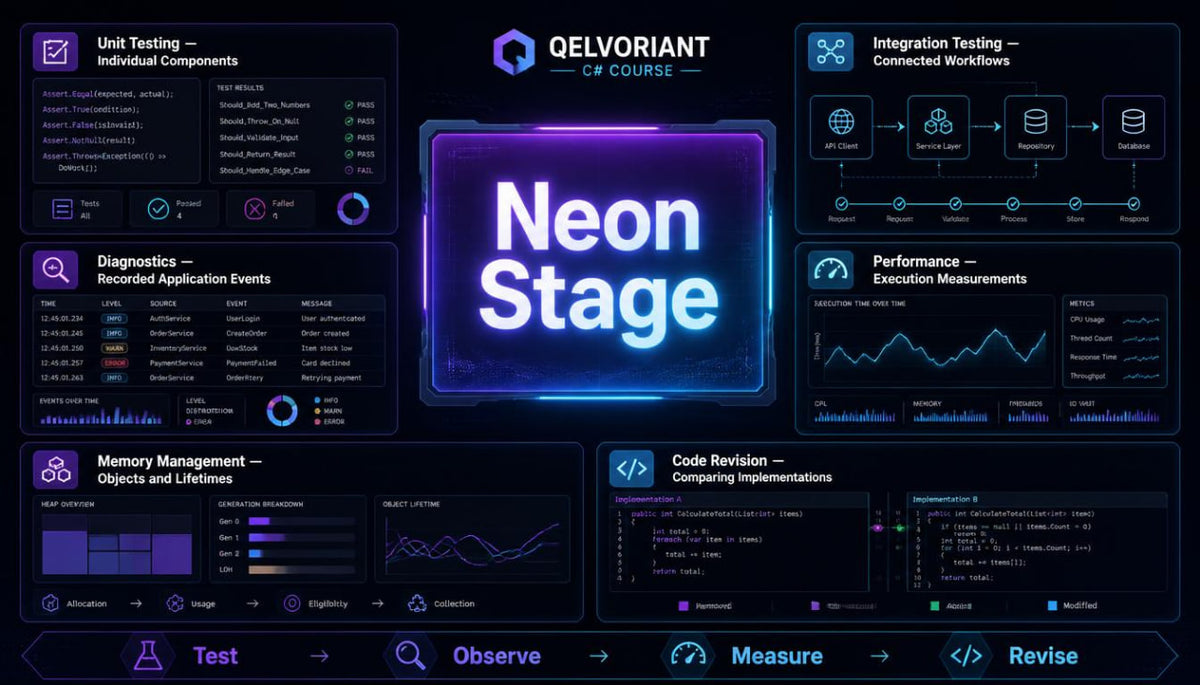
Neon Stage introduces structured approaches to investigating, testing, and refining C# applications through detailed technical lessons and practical exercises. The course explores automated testing, diagnostic records, performance analysis, memory behavior, and techniques for examining complex execution workflows. Each module connects theoretical concepts with annotated examples that demonstrate how specific application behaviors can be observed and evaluated. Guided activities encourage learners to construct test scenarios, interpret recorded information, compare different implementations, and investigate unexpected results. The concluding workshop combines these techniques within a connected application that processes records, coordinates operations, and produces diagnostic and performance reports.
3. What's Inside
Module 1 — Looking Beneath the Surface of Code
The opening module examines the relationship between an application's written instructions and its behavior during execution.
Learners explore why code that appears logically correct may behave differently when supplied with unusual information or executed under changing conditions.
The materials introduce application observability through recorded events, execution measurements, and examination of internal state.
Examples demonstrate how selected operations can be investigated without changing their intended responsibilities.
Learners examine the difference between detecting an unexpected result and identifying the underlying cause.
Practical activities involve tracing execution paths, reviewing calculated values, and documenting observations from several input scenarios.
Module 2 — Testing Individual Components
This module introduces automated unit testing as a structured approach to examining individual programming operations.
Learners study test cases, expected results, assertions, and the relationship between a testing scenario and the code being evaluated.
The materials demonstrate how methods can be examined with ordinary values, boundary conditions, and invalid inputs.
Examples include calculations, record classification, input validation, and collection-processing operations.
The course also examines how separating responsibilities into small methods can make individual behaviors clearer to evaluate.
Exercises involve designing test cases, comparing actual and expected results, and revising implementations when differences are identified.
A guided activity introduces a collection of tests for a fictional record-processing component.
Module 3 — Testing Connected Application Components
Individual components may behave as intended while their interactions introduce unexpected problems.
This section examines integration testing and the evaluation of connected application operations.
Learners explore scenarios in which validation, data processing, storage, and reporting components exchange information.
The materials explain how test data can be arranged to represent different application conditions.
Examples demonstrate testing workflows with empty records, incomplete information, duplicate entries, and interrupted operations.
The course also discusses replacing external dependencies with controlled alternatives during selected testing activities.
Practical exercises encourage learners to investigate component boundaries and document how information changes throughout a workflow.
Module 4 — Diagnostics and Meaningful Application Records
When an application encounters an unexpected condition, recorded information can provide valuable context.
This module introduces structured diagnostic messages and examines their role in understanding execution behavior.
Learners study how applications can record operations, errors, timestamps, and selected contextual details.
The materials distinguish informational records from warnings and error reports.
Examples demonstrate creating meaningful diagnostic entries for record validation, data processing, and asynchronous operations.
The course also examines why recorded information should remain relevant to the investigated behavior and avoid unnecessary exposure of sensitive values.
Exercises involve interpreting diagnostic sequences, identifying where an operation changed direction, and revising unclear messages.
Module 5 — Measuring Execution Performance
Performance questions become easier to investigate when observations are supported by measurements.
This module examines techniques for evaluating execution duration and comparing alternative implementations.
Learners explore timing operations, repeated measurements, and factors that influence recorded execution values.
The materials introduce Stopwatch and demonstrate how selected calculations can be measured within controlled scenarios.
Examples compare different approaches to searching collections, processing records, and organizing repeated operations.
The course explains why a single measurement may not represent ordinary application behavior.
Practical exercises involve collecting timing data, comparing results, and discussing the tradeoffs between execution characteristics and code readability.
Module 6 — Memory Behavior and Object Lifetimes
Memory management influences how C# applications create, retain, and release information.
This module introduces managed memory, object allocation, and garbage collection through detailed explanations.
Learners examine how objects are created, how references connect them, and how unnecessary retention can affect application behavior.
The materials explain the distinction between managed memory cleanup and the deliberate release of external resources.
Examples demonstrate temporary object creation, collection growth, and the consequences of retaining references beyond their intended use.
Additional activities examine disposable resources and object lifetimes within connected workflows.
Learners practice reviewing code structures, identifying unnecessary allocations, and interpreting memory-related observations.
Module 7 — Investigating Concurrency Under Pressure
Applications containing several concurrent operations can exhibit behavior that is difficult to reproduce through ordinary test cases.
This module connects earlier concurrency concepts with structured diagnostic and testing techniques.
Learners explore race conditions, shared-state changes, synchronization boundaries, and task cancellation through controlled examples.
The materials introduce techniques for recording execution order and comparing results across repeated operations.
Examples involve concurrent record updates, grouped tasks, and processing interruptions.
The course also examines how unusual timing conditions can reveal incorrect assumptions about task coordination.
Practical exercises involve analyzing execution logs, identifying conflicting operations, and revising synchronization strategies.
Module 8 — Revising Code with Evidence
The final technical module examines how diagnostic observations and test results can guide code revisions.
Learners study the relationship between an observed problem, a proposed change, and the behavior of the revised implementation.
The materials introduce a structured sequence of investigation, measurement, modification, and reevaluation.
Examples demonstrate revising inefficient collection operations, reducing repeated calculations, and reorganizing tightly connected methods.
The course also discusses how readability and maintainability remain relevant when evaluating technical changes.
Exercises encourage learners to compare original and revised implementations and explain the reasoning behind each modification.
Applied Workshop — The Application Insight Studio
The concluding workshop combines the central subjects of Neon Stage within a detailed C# record-processing application.
Learners begin with a fictional information-management system containing record definitions, validation components, collection operations, and asynchronous processing tasks.
The first stage introduces automated tests for individual calculation and validation methods.
The second stage examines interactions between record storage, processing logic, and reporting components.
Learners then introduce structured diagnostic records describing application operations and unexpected conditions.
Additional activities involve measuring selected processing routines and examining changes in memory allocation.
A concurrency investigation introduces overlapping record updates and task cancellation.
Learners analyze the resulting observations, identify possible causes of unexpected behavior, and revise selected components.
The workshop concludes with a technical review document containing testing observations, performance measurements, code changes, and explanations of the application's resulting behavior.
4. Who Is This For?
Neon Stage is intended for learners who have already studied C# application architecture, asynchronous programming, concurrency, and structured data processing.
The course is suitable for individuals interested in understanding how applications behave during execution and how technical problems can be investigated through observable information.
It may also be useful for learners who have developed connected C# applications and want further practice with automated testing, diagnostics, and performance evaluation.
Familiarity with classes, interfaces, collections, exceptions, tasks, and synchronization concepts is recommended.
The materials emphasize analytical thinking, careful observation, controlled experimentation, and documented technical reasoning.
Learners are encouraged to examine examples, design test scenarios, interpret execution records, and compare alternative implementations.
5. What You'll Learn
Through the written lessons, technical examples, and applied coding activities, learners will explore:
-
Application observability: Examine internal behavior through diagnostic information and execution measurements.
-
Unit testing: Create focused tests for individual methods and programming components.
-
Integration testing: Evaluate interactions between related application components.
-
Test case design: Develop scenarios involving ordinary, boundary, and invalid inputs.
-
Assertions: Compare calculated results with defined expectations.
-
Diagnostic records: Create and interpret structured application messages.
-
Performance measurement: Examine execution duration and compare implementations.
-
Memory management: Understand object allocation, references, and garbage collection.
-
Resource lifetimes: Investigate resource ownership and cleanup responsibilities.
-
Concurrency investigation: Examine shared-state behavior and synchronization issues.
-
Cancellation testing: Evaluate application behavior during interrupted operations.
-
Code analysis: Connect unexpected results with specific instructions and component relationships.
-
Evidence-based revision: Compare application behavior before and after code changes.
-
Technical documentation: Record observations, test findings, and implementation decisions.
-
Practical application study: Evaluate and revise a connected C# record-processing system.
6. Course Purchase and 30-Day Refund Information
Neon Stage is a paid C# educational course containing structured written lessons, detailed technical explanations, annotated code examples, testing exercises, and an applied application-analysis workshop.
30-Day Refund Period
Learners may submit a refund request within 30 days of purchase, according to the conditions described in Qelvoriant's published Refund Policy.
The policy explains the relevant eligibility requirements, request procedure, and refund processing details.
- 📥 Digital file available after purchase
- 📚 Long-term availability
- 🔒 Secure checkout
- 📅 Content updated in 2026
Self-paced learning overview
How are Qelvoriant courses organized?
How are Qelvoriant courses organized?
Our C# courses follow a structured approach that connects technical explanations with practical coding exercises. Each course covers a defined set of topics through written lessons, examples, and review activities. The collection progresses from introductory concepts toward deeper programming techniques and application design.
Do I need previous programming experience?
Do I need previous programming experience?
The required starting knowledge depends on the course you choose. Introductory materials explain foundational programming ideas, while later courses explore topics that benefit from earlier C# study. We recommend reading each course outline to understand its subject matter and suggested preparation.
Can I study the materials at my own pace?
Can I study the materials at my own pace?
The courses are arranged for independent study, allowing learners to work through the written explanations and exercises according to their own schedules. You can revisit earlier topics, examine code examples, and repeat practice activities when additional review is helpful.
Share