Qelvoriant
Luma Module
Luma Module
Couldn't load pickup availability
1. Problem Statement
As learners move beyond basic object-oriented C# programming, working with larger groups of information introduces additional questions about data organization and processing. Collections may contain different types of records, while operations involving filtering, searching, and modifying information require careful logical planning. Unexpected input values and inconsistent data structures can interrupt an application's intended behavior. Learners may also encounter difficulties deciding how to separate validation, calculations, and collection management into understandable components. Without guided experience in these areas, building applications that handle varied information can become a confusing process.
2. Solution
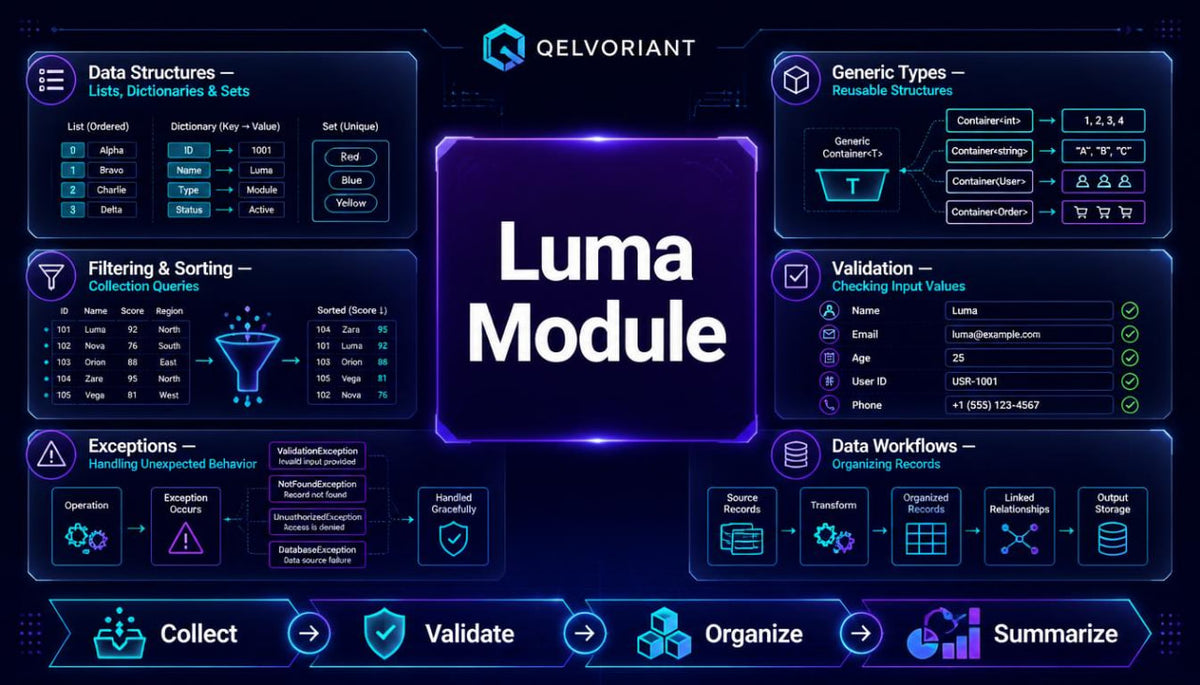
Luma Module introduces structured approaches to data handling through connected C# lessons and practical coding examples. The course examines collection structures, generic types, data validation, exception handling, and reusable processing methods. Each module explains the purpose of a particular technique before demonstrating its application within a broader coding task. Guided activities encourage learners to examine different data scenarios, organize processing steps, and investigate unexpected behavior. The concluding workshop combines these topics in a small information-management application built around collecting, validating, organizing, and summarizing records.
3. What's Inside
Module 1 — When Data Becomes a Structure
The opening module examines how C# applications represent and organize groups of related information.
Learners revisit arrays and introductory collections before exploring situations that require more flexible data structures.
The materials explain how collection choice influences the operations used to add, retrieve, update, and examine information.
Examples demonstrate working with lists of records, identifying individual elements, and organizing information according to selected attributes.
The module also introduces the difference between an individual object and a collection containing several objects.
Practical exercises involve organizing fictional records, examining collection behavior, and selecting suitable structures for defined coding tasks.
Module 2 — Collections with Different Responsibilities
Different programming tasks require different ways of arranging information.
This module introduces lists, dictionaries, and sets through examples that demonstrate their individual characteristics.
Learners examine indexed collections, key-value relationships, and structures designed around distinct entries.
The materials explain how insertion, searching, removal, and membership checks differ between collection types.
Examples include organizing category records, maintaining identifier-based information, and identifying repeated entries.
A dedicated practice section encourages learners to compare collection structures using the same fictional dataset.
The module concludes with a guided activity in which learners construct a small catalog and retrieve records through different criteria.
Module 3 — Generic Types and Reusable Structures
As applications grow, similar operations may need to work with different kinds of information.
This section introduces generic types and examines how C# represents reusable structures without tying every operation to one specific data type.
Learners study generic collections, type parameters, and introductory generic methods.
The materials demonstrate how a method can receive values of different types while retaining meaningful type information.
Annotated examples compare separate methods written for individual types with a shared generic approach.
Exercises involve examining method declarations, interpreting type parameters, and developing small reusable operations.
The module also discusses situations where a simpler, type-specific implementation may be more appropriate for a particular task.
Module 4 — Filtering, Searching, and Shaping Information
Once information has been organized, an application often needs to examine selected records or produce calculated summaries.
This module focuses on common data-processing operations within C# collections.
Learners explore filtering records according to conditions, sorting values, locating matching entries, and grouping related information.
The course introduces query expressions and method-based collection operations through annotated examples.
Practical scenarios include identifying records within a numerical range, arranging entries alphabetically, and calculating totals for selected categories.
Additional exercises examine how several operations can be combined into a connected processing sequence.
The module concludes with a comparison of different approaches to retrieving and summarizing collection information.
Module 5 — Validation Before Processing
Applications frequently receive information that must be examined before it can be used meaningfully.
This module introduces data validation and explains how input rules contribute to predictable processing behavior.
Learners examine techniques for checking numerical ranges, required text values, and record completeness.
Examples demonstrate how validation methods can be separated from the operations that modify or summarize information.
The materials also discuss the difference between invalid data and unexpected failures during execution.
Practice activities involve designing validation rules, examining rejected records, and recording understandable explanations for invalid entries.
A guided exercise introduces a small record-registration process in which information is reviewed before being added to a collection.
Module 6 — Understanding Exceptions and Unexpected Behavior
Even carefully arranged code may encounter situations that interrupt an intended operation.
This module explores exception handling and its role within C# applications.
Learners study try, catch, and finally structures through examples involving invalid conversions and operations that cannot be completed.
The course explains why different failures may require different responses and how exception information can assist investigation.
Additional discussions examine the distinction between handling an anticipated invalid value and responding to an exceptional condition.
Exercises invite learners to trace execution paths, identify the source of a failure, and revise selected sections of code.
The section concludes with practical considerations for creating understandable error messages.
Module 7 — From Separate Operations to a Connected Workflow
The final technical module examines how data representation, validation, collection handling, and processing can work together.
Learners explore dividing a workflow into smaller methods with distinct responsibilities.
Examples demonstrate collecting information, checking its structure, storing accepted entries, and calculating summaries.
The materials introduce the relationship between processing order and the state of an application.
Review activities encourage learners to examine data movement between objects and methods.
The module also discusses how to revise a processing sequence when additional requirements are introduced.
Applied Workshop — The Activity Record Studio
The concluding workshop brings the course concepts together through a small C# information-management application.
Learners work with fictional activity records containing identifiers, descriptive categories, numerical values, and dates.
The workshop begins with defining record structures and choosing suitable collections.
Subsequent stages introduce data validation, adding records, retrieving selected entries, and organizing information according to different criteria.
Learners develop methods for calculating category summaries and identifying records that meet specified conditions.
The workshop also includes examples of invalid information and unexpected processing behavior.
Additional activities encourage learners to revise the application's structure, introduce new categories, and explain how information moves between components.
4. Who Is This For?
Luma Module is intended for learners who already understand foundational C# syntax, methods, classes, and introductory object-oriented concepts.
It is suitable for individuals who want to study collection structures, reusable data-processing techniques, and the organization of information within applications.
The course may also be useful for learners who have previously written small C# programs and want more detailed practice with validation, collection operations, and exception handling.
Familiarity with variables, loops, conditional statements, classes, and methods is recommended.
The materials emphasize independent analysis, code reading, practical experimentation, and the thoughtful organization of programming tasks.
Learners are encouraged to examine the examples carefully, complete the guided exercises, and explore different approaches to handling information.
5. What You'll Learn
Through the course materials and applied exercises, learners will explore:
-
Collection structures: Organize information using lists, dictionaries, and sets.
-
Data representation: Create meaningful structures for storing related records.
-
Generic programming: Understand generic types, type parameters, and reusable methods.
-
Collection operations: Add, retrieve, update, and remove entries.
-
Filtering techniques: Select records according to specified conditions.
-
Sorting and grouping: Arrange information and identify related entries.
-
Data summaries: Calculate totals and examine selected groups of records.
-
Input validation: Develop rules for examining incoming information.
-
Exception handling: Interpret and respond to unexpected execution conditions.
-
Method organization: Divide processing workflows into smaller responsibilities.
-
Code investigation: Trace data movement and examine unexpected results.
-
Application structure: Connect collection management, validation, and reporting operations.
-
Practical development: Construct and revise a small record-management application.
6. Course Purchase and 30-Day Refund Information
Luma Module is a paid educational course containing structured written lessons, annotated C# examples, guided coding activities, and practical review materials.
30-Day Refund Period
Learners may submit a refund request within 30 days of purchase, subject to the conditions described in Qelvoriant's published Refund Policy.
The policy explains the applicable requirements, request procedure, and refund processing information. Learners are encouraged to review these details before purchasing.
- 📥 Digital file available after purchase
- 📚 Long-term availability
- 🔒 Secure checkout
- 📅 Content updated in 2026
Self-paced learning overview
How are Qelvoriant courses organized?
How are Qelvoriant courses organized?
Our C# courses follow a structured approach that connects technical explanations with practical coding exercises. Each course covers a defined set of topics through written lessons, examples, and review activities. The collection progresses from introductory concepts toward deeper programming techniques and application design.
Do I need previous programming experience?
Do I need previous programming experience?
The required starting knowledge depends on the course you choose. Introductory materials explain foundational programming ideas, while later courses explore topics that benefit from earlier C# study. We recommend reading each course outline to understand its subject matter and suggested preparation.
Can I study the materials at my own pace?
Can I study the materials at my own pace?
The courses are arranged for independent study, allowing learners to work through the written explanations and exercises according to their own schedules. You can revisit earlier topics, examine code examples, and repeat practice activities when additional review is helpful.
Share