Qelvoriant
Cipher Pattern
Cipher Pattern
Couldn't load pickup availability
1. Problem Statement
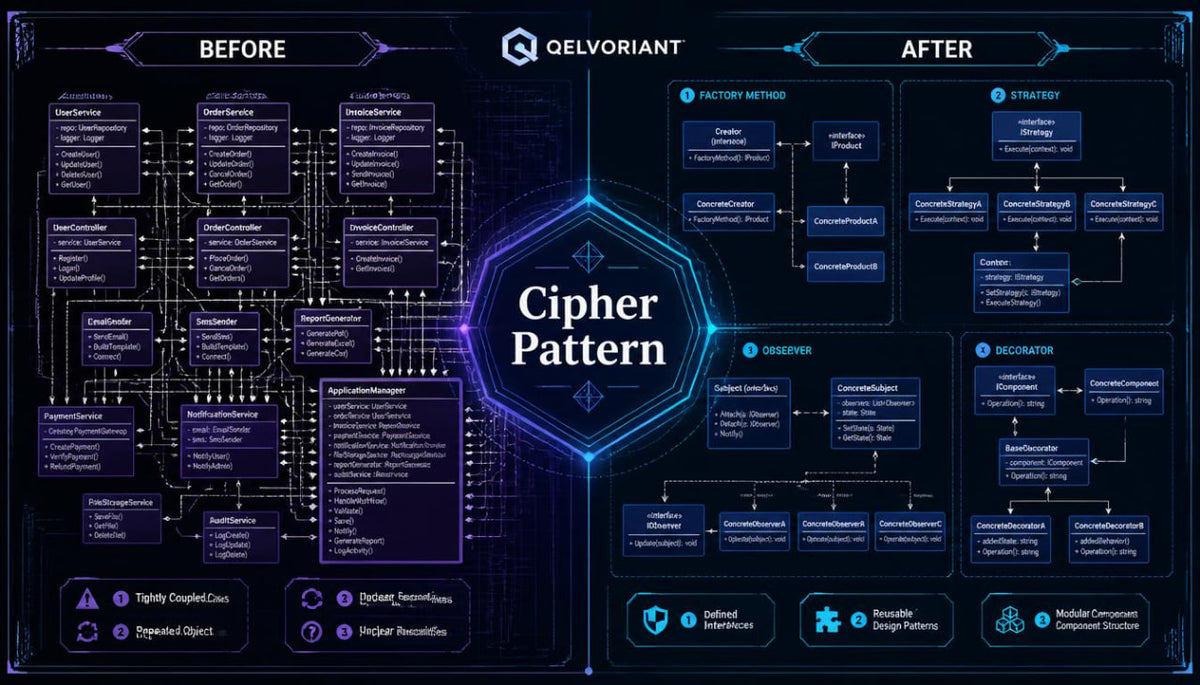
As C# applications become more detailed, coordinating multiple classes and responsibilities can introduce complicated relationships between components. Learners may understand object-oriented concepts but remain uncertain about how to organize code when several objects depend on one another. Repeated construction logic, tightly connected classes, and unclear responsibilities can make existing applications difficult to modify. Introducing new requirements may also reveal structural weaknesses that were not apparent when an application contained fewer operations. Without practical experience examining design alternatives, learners can struggle to determine which structures fit particular programming requirements and how different components should interact.
2. Solution
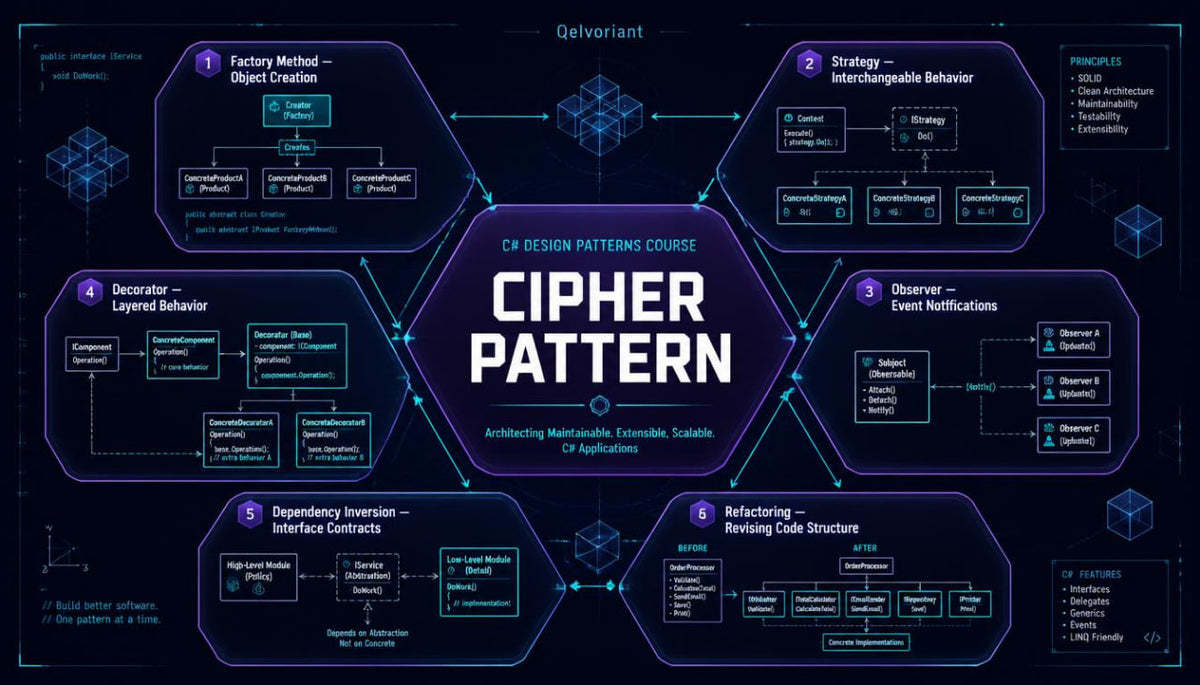
Cipher Pattern introduces established C# design patterns through structured lessons that connect architectural concepts with practical coding situations. The course explores object creation, behavioral organization, component relationships, and approaches to reducing unnecessary dependencies. Each module presents a programming scenario, examines its structural challenges, and demonstrates how a particular design pattern can be applied. Guided exercises encourage learners to compare implementations, identify responsibilities, and revise application structures according to changing requirements. A concluding workshop brings several patterns together within a modular document-processing application designed for independent examination and further development.
3. What's Inside
Module 1 — The Architecture Hidden Between Classes
The opening module examines how relationships between classes influence the structure of a C# application.
Learners revisit encapsulation, interfaces, composition, and object collaboration through examples involving connected components.
The materials introduce the relationship between individual responsibilities and the wider organization of an application.
Examples demonstrate how a class with several unrelated responsibilities can become difficult to revise when new requirements appear.
Learners explore cohesion, coupling, and the importance of defining clear boundaries between components.
Practical activities involve reviewing class structures, identifying dependencies, and drawing simple diagrams that describe how information moves between objects.
Module 2 — Design Patterns as Reusable Ideas
This module introduces design patterns as documented approaches to recurring programming situations.
Learners examine the distinction between a design pattern and a complete implementation.
The course explains how similar structural ideas can appear in different applications while requiring different implementation details.
The materials introduce three broad categories: creational, structural, and behavioral patterns.
Annotated examples demonstrate how a design decision can influence object creation, communication, and responsibility distribution.
Exercises encourage learners to examine programming requirements and consider several organizational approaches before selecting a pattern.
The module also discusses why adding an unnecessary pattern can make a small application harder to understand.
Module 3 — Factory Pattern: Organizing Object Creation
Applications sometimes need to create different kinds of objects according to input values or application conditions.
This module introduces the Factory Method pattern and examines how object creation responsibilities can be organized.
Learners study interfaces, concrete classes, factory methods, and the relationship between requested behavior and object construction.
Examples involve creating different document handlers from a shared interface.
The materials demonstrate how construction logic can be separated from code that works with created objects.
Practical exercises involve adding new object types, modifying factory conditions, and examining the resulting dependencies.
A guided activity invites learners to design a small document-creation workflow with several interchangeable implementations.
Module 4 — Strategy Pattern: Changing Behavior Without Rewriting the Structure
Different situations may require different operations while sharing the same general workflow.
This module examines the Strategy pattern as an approach to representing interchangeable behaviors.
Learners explore interfaces that describe common operations and classes that implement different processing rules.
Examples demonstrate alternative sorting methods, calculation routines, and text-processing operations.
The materials explain how a coordinating component can work with a selected strategy without containing every implementation detail.
Exercises involve replacing conditional structures with separate strategy classes and comparing the resulting code.
The module also examines how behavior can be selected during object construction or supplied through a method parameter.
Module 5 — Observer Pattern: Coordinating Related Components
Some applications contain components that need to respond when another component changes its state.
This module introduces the Observer pattern and connects its underlying ideas with previously studied C# events.
Learners examine the relationship between a subject, its observers, and the notifications that connect them.
Examples demonstrate how document changes can trigger related operations without requiring direct calls to every interested component.
The materials examine subscription behavior, notification responsibilities, and the handling of changing observer relationships.
Practical exercises involve developing a small notification structure and examining how several components respond to one event.
Learners also compare direct method calls with notification-based communication.
Module 6 — Decorator Pattern: Extending Component Behavior
This section explores how additional operations can be introduced around an existing component.
Learners study the Decorator pattern through examples involving text formatting, document preparation, and structured output.
The materials explain how decorators implement a shared interface while containing another object that follows the same contract.
Annotated examples demonstrate combining several decorators to perform connected operations.
Learners examine the order in which decorators are applied and how that order can influence the resulting behavior.
Exercises involve creating new decorators, arranging processing sequences, and comparing decorated objects with ordinary implementations.
The module also discusses the difference between extending behavior through composition and extending class structures through inheritance.
Module 7 — Dependency Inversion and Component Boundaries
Applications often become difficult to revise when high-level operations directly depend on specific implementation classes.
This module examines dependency inversion and the use of interfaces to describe component relationships.
Learners explore how dependencies can be supplied through constructors rather than created inside every class that needs them.
Examples involve a document service working with interchangeable storage and reporting components.
The course introduces constructor injection and explains how externally supplied dependencies affect component organization.
Practical exercises involve identifying tightly connected classes and revising their structures around defined interfaces.
Additional activities examine how alternate implementations can be introduced without changing unrelated application operations.
Module 8 — Refactoring with Structural Awareness
The final technical module explores how existing code can be reorganized while preserving its intended behavior.
Learners examine repeated conditional logic, oversized classes, unclear method responsibilities, and unnecessary dependencies.
The materials introduce small refactoring activities focused on class boundaries, method extraction, and interface design.
Examples demonstrate how design patterns can emerge from actual requirements rather than being introduced before a problem is understood.
The course also examines the importance of testing existing behavior before and after structural changes.
Exercises invite learners to compare original and revised implementations, explain the differences, and evaluate the clarity of their component relationships.
Applied Workshop — The Document Workflow Studio
The concluding workshop combines several design patterns within a connected C# application.
Learners work with fictional document records containing identifiers, categories, descriptive information, and processing instructions.
The application begins with a collection of document classes that implement shared interfaces.
A factory component creates appropriate document handlers according to the selected document category.
Separate strategies describe different processing rules, allowing the application to select operations according to the task.
Decorators introduce additional formatting and reporting behavior around existing components.
An observer-based notification structure communicates changes to related application sections.
Constructor injection connects processing components with their dependencies through defined interfaces.
The workshop includes guided stages for organizing classes, examining object relationships, testing individual operations, and introducing new requirements.
A final review activity asks learners to explain the responsibilities of each component and identify where alternative implementations could be introduced.
4. Who Is This For?
Cipher Pattern is intended for learners who have already studied C# classes, interfaces, collections, delegates, events, and introductory application organization.
The course is suitable for individuals who want to examine the architectural decisions behind connected programming components.
It may also be useful for learners who have worked with object-oriented applications and want additional practice understanding design patterns and structural relationships.
Previous familiarity with inheritance, composition, interfaces, and method organization is recommended.
The materials focus on examining programming decisions, comparing alternative structures, and understanding why a particular design approach may fit a defined requirement.
Learners are encouraged to study the examples carefully, create class diagrams, revise existing implementations, and complete the practical coding activities.
5. What You'll Learn
Through the written lessons, annotated examples, and applied exercises, learners will explore:
-
Design pattern fundamentals: Recognize recurring structural and behavioral programming situations.
-
Class responsibilities: Organize application components around clearly defined tasks.
-
Creational patterns: Examine the Factory Method pattern and approaches to object construction.
-
Behavioral patterns: Study Strategy and Observer patterns within connected application workflows.
-
Structural patterns: Apply the Decorator pattern to extend component behavior.
-
Object composition: Understand relationships between collaborating objects.
-
Interface design: Describe shared component contracts through C# interfaces.
-
Dependency inversion: Examine how abstractions influence relationships between classes.
-
Constructor injection: Supply dependencies through defined construction parameters.
-
Component communication: Compare direct method calls with event-oriented notification structures.
-
Code refactoring: Reorganize selected sections of code while maintaining intended operations.
-
Architectural diagrams: Represent classes, responsibilities, and object relationships.
-
Testing considerations: Examine how modular structures support focused checks of individual operations.
-
Practical application design: Combine several patterns within a connected document-processing project.
6. Course Purchase and 30-Day Refund Information
Cipher Pattern is a paid C# educational course containing structured written lessons, architectural explanations, annotated code examples, design exercises, and a guided application workshop.
30-Day Refund Period
Learners may request a refund within 30 days of purchase under Qelvoriant's published Refund Policy.
The policy describes the applicable conditions, request procedure, and details concerning refund processing. Learners are encouraged to review these terms before completing their purchase.
- 📥 Digital file available after purchase
- 📚 Long-term availability
- 🔒 Secure checkout
- 📅 Content updated in 2026
Self-paced learning overview
How are Qelvoriant courses organized?
How are Qelvoriant courses organized?
Our C# courses follow a structured approach that connects technical explanations with practical coding exercises. Each course covers a defined set of topics through written lessons, examples, and review activities. The collection progresses from introductory concepts toward deeper programming techniques and application design.
Do I need previous programming experience?
Do I need previous programming experience?
The required starting knowledge depends on the course you choose. Introductory materials explain foundational programming ideas, while later courses explore topics that benefit from earlier C# study. We recommend reading each course outline to understand its subject matter and suggested preparation.
Can I study the materials at my own pace?
Can I study the materials at my own pace?
The courses are arranged for independent study, allowing learners to work through the written explanations and exercises according to their own schedules. You can revisit earlier topics, examine code examples, and repeat practice activities when additional review is helpful.
Share