Qelvoriant
Arc Library
Arc Library
Couldn't load pickup availability
1. Problem Statement
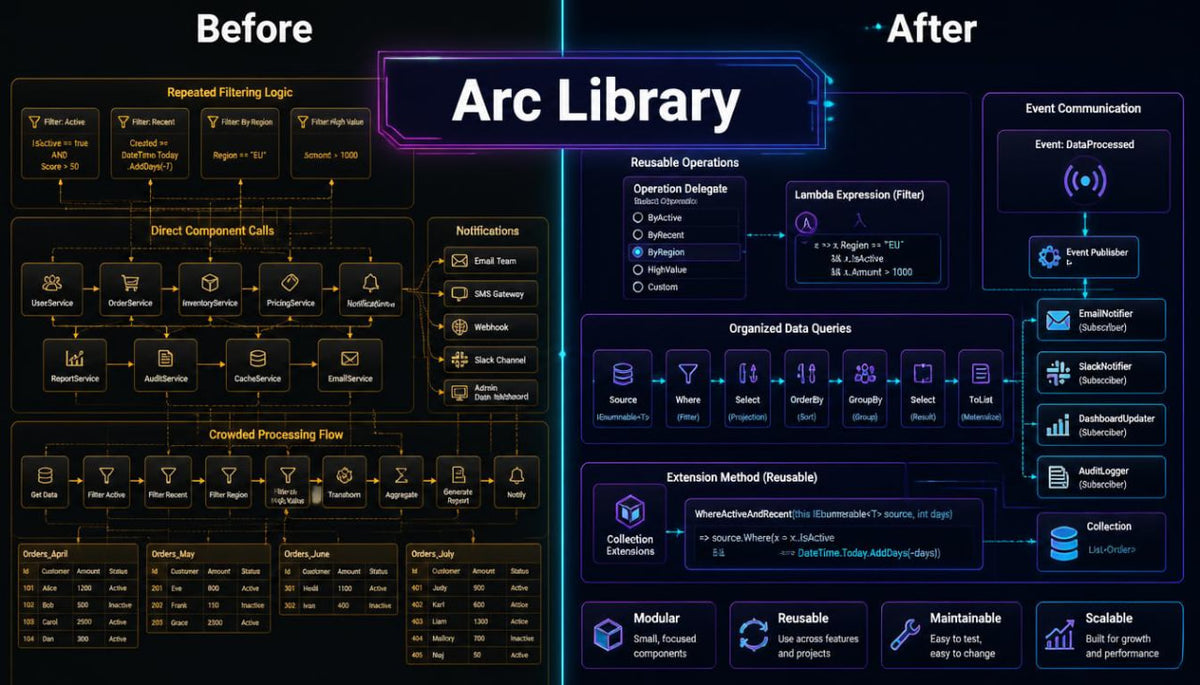
As C# applications develop beyond basic collection handling and object-oriented structures, coordinating operations between different components introduces additional technical challenges. Learners may understand individual methods and classes but remain uncertain about how to connect them without creating unnecessary dependencies. Repeated filtering operations, complicated conditional structures, and tightly connected components can make existing code difficult to revise. Delegates, events, lambda expressions, and query operations introduce unfamiliar syntax that may appear disconnected from previously studied programming concepts. Without a clear understanding of how these techniques relate, learners can find it challenging to design reusable processing workflows and maintain understandable application structures.
2. Solution
Arc Library introduces advanced C# language features through connected lessons that build upon previously studied collection and class structures. The course explains delegates, lambda expressions, events, query operations, and extension methods through annotated examples and guided activities. Each module explores how a particular technique can address a defined programming requirement while maintaining clear relationships between components. Practical workshops encourage learners to compare different implementations, examine execution behavior, and reorganize existing code into reusable operations. A concluding application project brings the studied concepts together through a modular information-processing system with event notifications, configurable operations, and structured reporting.
3. What's Inside
Module 1 — Methods That Travel Between Components
The opening module examines how C# methods can participate in flexible programming structures through delegates.
Learners study delegate declarations, method references, and the relationship between a delegate's signature and the methods it can represent.
The materials introduce the distinction between calling a method directly and passing a reference to an operation.
Annotated examples demonstrate how different processing methods can be selected according to a particular task.
Learners also explore built-in delegate types, including Action and Func, and examine situations where these declarations can simplify method signatures.
Practical exercises involve constructing small calculation routines, comparing delegate assignments, and examining how values pass between connected operations.
The module concludes with an activity that organizes several data-processing methods behind a shared delegate structure.
Module 2 — Lambda Expressions and Compact Logic
Lambda expressions provide another way to represent operations within C# code.
This module examines their syntax, parameters, expression bodies, and statement bodies.
Learners explore how lambda expressions relate to delegates and how they can be used to define short operations within a surrounding method.
Examples introduce numerical comparisons, text evaluation, and record-selection rules.
The materials explain variable capture and the relationship between a lambda expression and values declared in its surrounding scope.
Special attention is given to readability when expressions contain several conditions.
Practice activities involve converting selected named methods into lambda expressions, examining captured variables, and comparing alternative implementations.
Module 3 — Queries That Give Collections Direction
This section develops collection-processing knowledge through more detailed C# query operations.
Learners examine how sequences can be filtered, projected, sorted, and grouped according to defined conditions.
The materials introduce query syntax alongside method-based expressions, including Where, Select, OrderBy, and GroupBy.
Examples demonstrate selecting records by category, arranging entries according to numerical values, and constructing summaries from related information.
The module also examines deferred execution and explains how the timing of query evaluation can influence observed results.
Learners explore the distinction between defining a query and creating a stored collection of its results.
Exercises involve tracing query operations, evaluating changes to source collections, and comparing several approaches to the same processing requirement.
Module 4 — Events and Communication Between Objects
Applications often contain components that need to respond when another component performs a particular operation.
This module introduces events and examines how they support communication between related objects.
Learners study event declarations, subscriptions, handlers, and the relationship between delegates and event notifications.
Guided examples demonstrate how an application can respond when a record is created, updated, or removed.
The materials explain why event handlers should have clearly defined responsibilities and how multiple subscribers can respond to one notification.
Additional discussions explore unsubscribing from events and managing object references.
Practical exercises involve constructing notification handlers, examining invocation order, and tracing interactions between event publishers and subscribers.
Module 5 — Extension Methods and Reusable Operations
This module explores how extension methods can provide additional operations for existing types.
Learners examine extension method declarations, static classes, and the use of the this modifier in method parameters.
Examples demonstrate creating reusable operations for formatting text, examining numerical values, and organizing record information.
The materials discuss how extension methods differ from instance methods and why their naming should communicate a clear purpose.
Learners also examine situations where ordinary helper methods may provide a more understandable structure.
Practice activities involve creating selected extension methods, comparing implementation approaches, and applying reusable operations to existing examples.
Module 6 — Processing Pipelines with Clear Boundaries
As several operations work together, understanding the sequence of processing becomes particularly important.
This section examines how filtering, validation, transformation, and reporting can form a connected workflow.
Learners explore the movement of information between methods and the responsibilities assigned to individual processing stages.
Examples demonstrate constructing a sequence that receives records, checks their properties, selects relevant entries, and produces calculated summaries.
The materials discuss how intermediate values can be examined during code investigation.
Additional exercises introduce changes to processing requirements and ask learners to revise selected stages without rewriting unrelated operations.
The module concludes with a comparison of different ways to organize connected calculations and selection rules.
Module 7 — Examining Behavior Through Targeted Tests
The final technical module focuses on understanding whether individual operations behave according to their intended rules.
Learners explore testing methods with representative inputs and comparing calculated values with expected results.
The materials introduce focused checks for collection queries, delegate-based operations, and event handlers.
Examples demonstrate testing empty collections, repeated values, invalid inputs, and alternative execution paths.
The course also examines how separating processing logic from communication responsibilities can simplify testing activities.
Exercises encourage learners to explain unexpected behavior, revise selected implementations, and document the reasoning behind their changes.
Applied Workshop — The Modular Reading Archive
The concluding workshop combines the central topics of Arc Library within a small C# application for organizing fictional reading records.
Learners begin by defining classes that represent entries, categories, descriptions, and numerical reading details.
A collection manager organizes the records, while separate processing methods perform filtering, sorting, and summary calculations.
Delegates allow selected operations to be supplied to processing methods.
Lambda expressions describe record-selection conditions, and extension methods provide additional formatting operations.
Events notify subscribed components when records are added or modified.
The workshop also introduces a reporting component that prepares summaries from the stored information.
Review activities involve examining event behavior, changing query conditions, testing different datasets, and revising component relationships.
An additional study activity invites learners to design another reporting operation using the same application structure.
4. Who Is This For?
Arc Library is intended for learners who have already studied foundational C# programming, classes, methods, collections, and introductory data-processing techniques.
The course is suitable for individuals who want to examine more detailed language features and understand how separate application components can communicate.
It may also be useful for learners who have encountered delegates, events, or lambda expressions in existing code and want a structured explanation of their purpose.
Previous familiarity with object-oriented concepts, generic collections, and method parameters is recommended.
The materials encourage careful code reading, comparison of alternative solutions, and independent experimentation.
Learners are invited to examine how different techniques influence application structure rather than treating every language feature as an isolated topic.
5. What You'll Learn
Through the lessons, annotated examples, and practical activities, learners will explore:
-
Delegate declarations: Understand method references and compatible signatures.
-
Built-in delegates: Examine
ActionandFuncwithin reusable operations. -
Lambda expressions: Write and interpret expressions containing parameters and processing logic.
-
Variable capture: Examine how lambda expressions interact with surrounding values.
-
Collection queries: Filter, project, sort, and group information.
-
Query evaluation: Understand deferred execution and stored query results.
-
Event handling: Create event declarations and respond to notifications.
-
Component communication: Connect objects through defined event relationships.
-
Extension methods: Develop reusable operations for existing types.
-
Processing workflows: Arrange validation, selection, calculation, and reporting into connected stages.
-
Code organization: Separate component responsibilities and examine dependencies.
-
Testing techniques: Evaluate operations against expected results and unusual input conditions.
-
Practical application design: Combine delegates, queries, events, and methods within a modular C# project.
6. Course Purchase and 30-Day Refund Information
Arc Library is a paid educational course containing structured written lessons, technical explanations, annotated C# examples, and practical coding activities.
30-Day Refund Period
Learners may submit a refund request within 30 days of purchase, according to the conditions outlined in Qelvoriant's published Refund Policy.
The policy describes the applicable eligibility requirements, request procedure, and refund processing details. Learners are encouraged to read these terms before completing a purchase.
- 📥 Digital file available after purchase
- 📚 Long-term availability
- 🔒 Secure checkout
- 📅 Content updated in 2026
Self-paced learning overview
How are Qelvoriant courses organized?
How are Qelvoriant courses organized?
Our C# courses follow a structured approach that connects technical explanations with practical coding exercises. Each course covers a defined set of topics through written lessons, examples, and review activities. The collection progresses from introductory concepts toward deeper programming techniques and application design.
Do I need previous programming experience?
Do I need previous programming experience?
The required starting knowledge depends on the course you choose. Introductory materials explain foundational programming ideas, while later courses explore topics that benefit from earlier C# study. We recommend reading each course outline to understand its subject matter and suggested preparation.
Can I study the materials at my own pace?
Can I study the materials at my own pace?
The courses are arranged for independent study, allowing learners to work through the written explanations and exercises according to their own schedules. You can revisit earlier topics, examine code examples, and repeat practice activities when additional review is helpful.
Share